
Live & Learn: What Homeschooling Has Taught Us
10/26/2021 23:15 Filed in: Getting Started
Five things homeschooling has taught us.
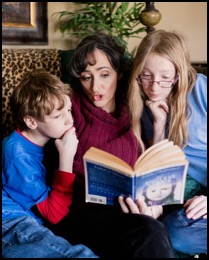
While it hasn’t always been an easy road, we’ve learned many valuable lessons along the way.
I’ve narrowed them down to five:
Lesson #1: Never Say Never.
Homeschooling was the last thing we thought we’d ever do. More accurately, it was something we said we’d never do.
Our first exposure to home schoolers – a couple of aloof kids in our church youth group – only confirmed the decision that we would “never do that to our kids.”
Our eldest daughter was two years old at the time and still an only child. We spent most of our time playing, doing art projects, and going places. We also read lots of books.
By the time she was four she could read fluently, although our goal was simply to enjoy the experience of reading and not to formally teach her to read. We never thought twice about it until a friend of ours, a former public school teacher, observed her and commented that she would be bored in Kindergarten. Our friend recommended that we look into another education option for our daughter so that she could keep advancing. Public school would “slow her down,” she said.
Our journey to find a private school ended almost as quickly as it began when we discovered the price tag for private schools. We concluded that unless we received a monetary windfall, private school was not an option for us.
By that time, we had become fast friends with a family who had been homeschooling their children. They invited us to attend a home school fair with them, but we had a prior commitment. Not to mention, we were still unconvinced about the whole “homeschooling thing.”
Months passed, and our circle of friends grew to include several home school families, some with older children who were quite different from the first home school kids we knew.
Which leads us to our next lesson learned:
Lesson #2: Homeschooling does not make children aloof, just as public schools do not turn children into social butterflies.
As we began to look into homeschooling, and meeting more homeschool families, we came to the realization that just because a child is home schooled does not mean that they are introverted or socially-aloof. Likewise, children who attend public school are not all extroverted, social butterflies.
We realized that a child’s social nature is largely influenced by his environment and people around him, not the physical location of his educational experience. Not all children in public schools are extroverts, and not all home schoolers are introverts.
Before we knew it, we found ourselves at a home school book fair near our home. The exhibit hall was wall-to-wall with curriculum options and learning resources. It was both encouraging and overwhelming at the same time!
We attended a few workshops, but were particularly impressed by the confident, articulate home school graduates who spoke during a forum about their homeschool experiences. A few had even received full college scholarships.
We had our eye on a particular curriculum, but the hall was so crowded that we could not get anywhere near the vendor’s table to see the materials up close. We went home empty-handed, but encouraged that homeschooling might be a viable option for us after all.
Lesson #3: “Education without values, as useful as it is, seems rather to make man a more clever devil.” -- C.S. Lewis.
Finding a curriculum is probably one of the most difficult decisions to make when beginning to home school. When we first began to seriously consider homeschooling, we were primarily concerned with academics. It wasn’t until later that we realized that the focus of our children’s schooling should be the Lord.
The curriculum which first piqued our interest, while Christian-based, drew us solely on the basis of its academics. In fact, our very reason to home school was predicated on the idea that our daughter needed an educational option that would allow her to advance academically.
We had it backward, but we didn’t know it until that curriculum failed us within the first few months of homeschooling. We were forced to look for something else, and that search led us to the revelation that the Lord needed to be first and foremost in our school if we were to truly succeed. We became convicted that the lessons placed in our daughter's heart were much more important and had far greater eternal significance than the information placed in her head. Without the former, the latter was irrelevant.
The true benefit of homeschooling is that it gives parents the ability to customize a child’s education to encompass not just intellectual growth, but personal and spiritual growth as well. We came to the conclusion that if education was all about challenging academics and high test scores, and if God wasn’t the central focus, then all we were doing was moving the humanist classroom into our dining room. This can happen even with a Christian-based curriculum.
We began asking ourselves: “What is our focus?” Was our goal to fill our daughter’s head with worldly knowledge? Or did we want a curriculum that helped her understand who God is by integrating His character into each lesson? Was high school graduation and a college scholarship the yardstick for success? Or was the measure of success something more?
The curriculum we chose next, at the recommendation of a homeschool friend at church, made a huge difference, not only in our daughter’s character development but also in her (and our) attitude towards school. It has stood the test of time and is a curriculum we still use to this day.
Lesson #4: Education is a lifestyle; not something done between certain hours at a certain place.
Just as the church service shouldn’t be the only place and time we worship and treat others with brotherly love, neither should the schoolroom be the only place and time that learning occurs.
From the beginning of our homeschooling journey, we were dedicated to the idea that education is an ongoing, life-long process, and we were excited that we could put that into practice in our home school. While we did keep regular “school hours” each day, we did not limit our children’s learning experiences to just those times. We loved the freedom that homeschooling gave us to be able to incorporate learning into every aspect of our lives, whether at the grocery store comparing prices, at the zoo observing animals, or in the garden pulling weeds.
Another valuable lesson we have been able to demonstrate to our children through our “education is a lifestyle” philosophy is that learning doesn’t stop once you reach a certain age. This is a huge fallacy that many students fall for once they’re “graduated” and think they know all there is to know.
When we made the commitment to home school, a few people made the comment: “School is a microcosm of society.” Absolutely not true. Where else in society do you find yourself around others who are all the same age you are? Okay, maybe Sunday school…but that’s a pet peeve of mine, and I often wonder why in the world churches feel the need to emulate the government school model.
Lesson #5: It’s not what we know, but Who we know that truly matters.
Looking back, I can’t put my finger on what specifically caused us to change our minds about home-schooling, except to say that it was the Lord’s leading. Trite but true. Having done a complete 180 on the subject of homeschooling, we have come to realize that the very fact that we were both in complete agreement about our commitment to home school was nothing short of a miracle.
Our reasons for homeschooling have matured over the years. Whereas we were first motivated by academics, our goals have become more diverse. There are myriad good reasons to home school, and the benefits far outweigh any inconvenience.
Why does our family choose to home school today? Here is a short list:
• Strong parent-child and sibling relationships.
• A tailor-made education to fit each child’s unique style of learning and array of interests.
• Positive social skills incorporating interactions between people of many different ages and levels of experience.
• Real world experiences under the guidance of a caring teacher who truly has the child’s best interest at heart.
• The freedom to engage in honest debate about controversial issues to sort out truth from propaganda.
• To provide a real education without indoctrination or “feel good” fluff.
• To equip our children with a love of learning and the tools they need to become life learners.
But beyond all of these many benefits, the one that far outweighs the others is that we can point our children to God, the Creator of everything and center of all knowledge. The way I see it, true education and wisdom begins and ends with Him, and without Him learning has no real significance.
According to the Westminster Catechism, man’s chief end is “to glorify God and enjoy Him forever.” As Christian home schoolers that should be the primary goal of our educational pursuits.
At the end of our lives, God isn’t going to ask, “Do you know about worms?” Or stars, or explorers, or classical literature, or even World History. His one question will be: “Do you know my Son?”
As the Lord has grown our family from one child to six, so has He grown our home school vision. With all the educational options available today for home school families, it is so easy to be tempted and side-tracked by our own vision for our children instead of God’s vision for them.
We must be vigilant not to short-change our children by offering them an educational counterfeit in the form of intellectual pursuits devoid of spiritual significance.
God’s plan is always better, and that’s a lesson we’re still learning.